
How to Reduce Government Fleet Operating Costs
Government fleets reduce operating costs by eliminating underutilized vehicles, automating maintenance scheduling, and enforcing policy. Agencies using fleet management software typically reduce cost-per-mile by 15–30% within 12 months. The highest-impact lever is right-sizing: many public sector fleets carry 20–35% more vehicles than operational demand requires.
On this page:
1. Where government fleet costs come from2. Right-sizing: the highest-ROI lever
3. Maintenance cost reduction
4. Risk mitigation and policy enforcement
5. How software accelerates savings
6. Real-world benchmarks
7. People also ask
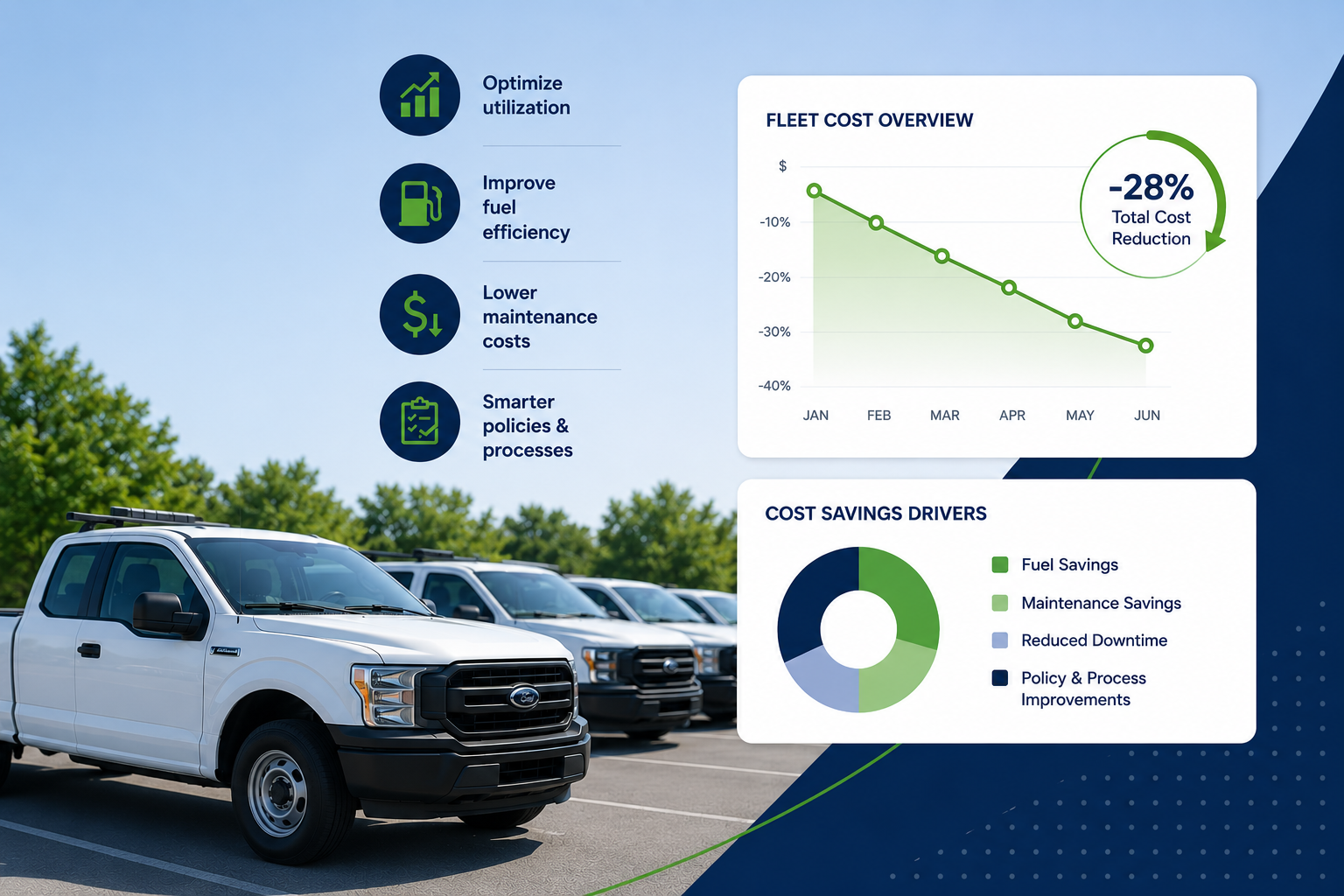
Where Government Fleet Costs Come From
Fleet operating cost breaks into four major categories. Understanding which drives the most spending in your fleet is the starting point for any reduction strategy.
| Cost Category | Typical % of Total | Primary Driver | Reduction Potential |
| Vehicle ownership (depreciation, financing) | 35-45% | Fleet size, replacement cycle | High |
| Maintenance and repair | 25-35% | PM compliance, age of fleet | High |
| Fuel | 15-25% | Utilization, driver behavior | Moderate |
| Administration and labor | 10-15% | Manual processes, reporting | Moderate |
Right-Sizing: The Highest ROI Lever
Fleet right-sizing is the process of aligning vehicle inventory to actual operational demand. For most government agencies, eliminating surplus vehicles is the single fastest path to cost reduction — each removed vehicle eliminates depreciation, insurance, maintenance, and storage costs simultaneously.
How to identify underutilized vehicles
- Pull monthly mileage reports — vehicles under 500 miles/month are candidates for review
- Cross-reference vehicle assignments against departmental headcount and shift schedules
- Analyze peak vs. average utilization to distinguish seasonal demand from true surplus
- Review vehicles parked more than 80% of business hours using GPS or motor pool data
- Segment by vehicle class — sedans and light trucks have different utilization thresholds
Maintenance Cost Reduction
Preventive maintenance compliance is the primary lever for reducing repair costs. Fleets that achieve 85%+ PM compliance rates typically reduce unscheduled repair spend by 20–40% compared to reactive maintenance programs. Automated maintenance scheduling — triggered by mileage, engine hours, or calendar intervals — is the most effective way to sustain compliance at scale.
Reactive vs. preventive maintenance: cost comparison
Reactive repairs cost 3–5x more than the equivalent preventive service when accounting for labor, parts, and vehicle downtime. A missed oil change that leads to engine damage illustrates the compounding effect: the PM costs ~$60; the resulting repair averages $4,000–$8,000.
Risk Mitigation and Policy Enforcement
Unenforced fleet policies are a direct cost driver. Unauthorized vehicle use, missed maintenance windows, and untracked personal mileage reimbursements each generate avoidable expenses that compound quietly over time. Automating policy enforcement through fleet management software eliminates these cost leaks at the source — without adding administrative burden. On average, 95% of drivers comply with fleet policies when enforcement is built into the system.
Where policy enforcement reduces cost directly
Eliminating unauthorized vehicle use
Driver eligibility rules prevent unapproved bookings at the point of reservation. Key kiosks release access only for authorized trips — reducing unauthorized mileage, wear, and liability that never appear in a standard utilization report.
Cutting personal mileage reimbursements
Requiring drivers to check motor pool availability before using a personal vehicle — enforced through the reservation system — can reduce POV reimbursement costs dramatically. One Agile Fleet client reduced annual reimbursement spend from $250,000 to $41,706 through this policy change alone.
Preventing reactive maintenance costs
Automated maintenance alerts enforce PM schedules before vehicles miss service windows. Reactive repairs cost 3–5x more than preventive service — and fleet software closes the gap between policy and practice that lets maintenance slide.
Recovering administrative staff time
Digital audit trails and automated billing eliminate manual record-keeping. One agency reduced billing administration from 30 hours per month to near-zero after implementing FleetCommander — freeing staff for work that actually reduces fleet costs.
How Fleet Management Software Accelerates Savings
Manual fleet operations rely on spreadsheets, paper logs, and reactive decision-making. Software centralizes utilization data, automates maintenance triggers, and produces the reporting needed to justify vehicle disposals to budget authorities — which is often the real barrier in government settings.
| Fleet Right-Sizing See how FleetCommander surfaces savings opportunities Schedule a 30-minute walkthrough with a public sector fleet specialist. | Request a Demo → |
People Also Ask
There is no single universal target, because acceptable utilization varies significantly by vehicle class and location. A passenger vehicle in a shared motor pool at 90% utilization would be considered strong performance. A specialized piece of heavy equipment at 40% utilization at the same fleet could also be considered appropriate given its mission-specific role.
Agile Fleet recommends benchmarking utilization thresholds in the 30–40% range as a starting point for identifying underperforming assets, then analyzing booking frequency, trip length, idle time, and seasonal patterns before making any right-sizing decisions. A single quarter of low utilization does not justify asset reduction — multi-period trend analysis is essential to avoid creating shortages during peak demand cycles.
The most effective agencies track utilization by vehicle class, by location, and by department — not just as an aggregate fleet-wide percentage — so that comparisons are meaningful and decisions are defensible.
Cost-per-mile is calculated by dividing total fleet operating costs by total miles driven over a given period. Total costs should include fuel, maintenance and repairs, insurance, depreciation or lease payments, and administrative overhead.
For government fleets, cost-per-mile is also a useful benchmark for evaluating the true cost of personally-owned vehicle (POV) reimbursements versus motor pool use. One Agile Fleet client, Scott County, found that motor pool vehicles cost approximately $0.38 per mile to operate versus $0.55 per mile paid out in POV reimbursements — a gap that reduced their annual reimbursement expense from $250,000 to $41,706 after implementing a vehicle-first reservation policy.
FleetCommander's reporting and fuel management modules centralize the data needed to calculate cost-per-mile accurately and track it over time, by vehicle class and location.
FleetCommander by Agile Fleet is the only fleet management information system (FMIS) listed in the FedRAMP Marketplace. Built on AWS GovCloud and aligned to NIST 800-53 controls, FleetCommander has achieved FedRAMP Authorization — the U.S. government's standardized framework for security assessment and continuous monitoring of cloud services.
For federal agencies, FedRAMP authorization is required for executive agency cloud systems. For state, local, and higher education fleets, FedRAMP is increasingly treated as a security standard that simplifies IT approval, accelerates procurement, and demonstrates that sensitive fleet data — driver records, trip histories, access logs — is protected to the highest available standard.
FedRAMP authorization also significantly streamlines the Authority to Operate (ATO) process for federal agencies, with pre-vetted documentation and security control inheritance that reduces internal compliance overhead.
The time required depends on whether automated fleet data is already available. For agencies using FleetCommander, utilization reports can be generated immediately, and a structured analysis can typically be completed within a few weeks. For agencies relying on manual records or spreadsheets, data collection alone can extend the process to several months.
Agile Fleet recommends analyzing at least 90 days of utilization data — and ideally a full year — before making vehicle reduction decisions. Seasonal demand variation is one of the most common causes of premature right-sizing mistakes. A fleet that appears underutilized in one quarter may face peak demand constraints in another.
Agile Fleet offers a complimentary Fleet Automation & Right-Sizing ROI Analysis for qualifying agencies. Request your free assessment →
Yes. FleetCommander integrates with a range of government systems including fuel card platforms (Voyager, WEX, Fleet One, Comdata, Fuel Masters), telematics providers, and accounting or ERP systems for automated chargeback and billing. The platform supports single sign-on (SSO) for integration with agency identity management systems.
For procurement, Agile Fleet makes purchasing straightforward for public agencies through several established contract vehicles. FleetCommander is available via GSA Schedule — where orders average 15 days versus 268 days through open market procurement — as well as through Sourcewell (Contract 020221-AAC) and a range of existing state, county, and municipal contracts. No per-user or per-site fees apply; pricing is based on fleet size only.
Learn more about procurement options at agilefleet.com/how-to-buy →